Evaporation and Spray Drying Considerations for Tea Extract Consistency
In an instant tea extraction plant, the extraction step may set the chemistry, but evaporation and spray drying decide whether that chemistry reaches the bag, drum, or sachet with consistency.
A clear, high-yield extract can still lose value downstream if it concentrates unevenly, fouls heat-transfer surfaces, forms insoluble powder, or dries into a product with unstable color and bulk density. For extraction managers, the practical question is not only how much soluble tea can be recovered. It is whether that recovered value can move through concentration and drying without creating new variability.
Enzymeready supports instant tea processors as an enzyme supplier for tea extraction processing, with application guidance focused on the full liquid-to-powder window: extraction, clarification, evaporation, and spray drying behavior.
Why evaporation performance starts upstream
Evaporators are often blamed for fouling, viscosity rise, and uneven concentration. In many plants, however, the root cause begins in the extract profile entering the evaporator.
Key upstream factors include:
- Fine suspended tea particles that carry into concentration
- Pectin-rich or hemicellulose-rich colloids that increase viscosity
- Incomplete liquor clarification before thermal load
- Variable extract solids from batch to batch
- Residence time swings during extraction
- Poorly controlled separation before concentration
Enzyme-assisted extraction can help reduce these sources of variation when it is matched correctly to the tea grade, cut size, extraction temperature, target solids, and clarification equipment. The goal is not to make the extract “thin” at any cost. The goal is to create a liquor that concentrates predictably while preserving the sensory and solubility profile required for the final instant tea powder.
The concentration window: where consistency is won or lost
During evaporation, tea extract becomes less forgiving. Small variations in insoluble load, viscosity, and thermal exposure can become amplified as solids increase.
Watch these operating signals
Extraction and evaporation teams should align around a shared set of process indicators:
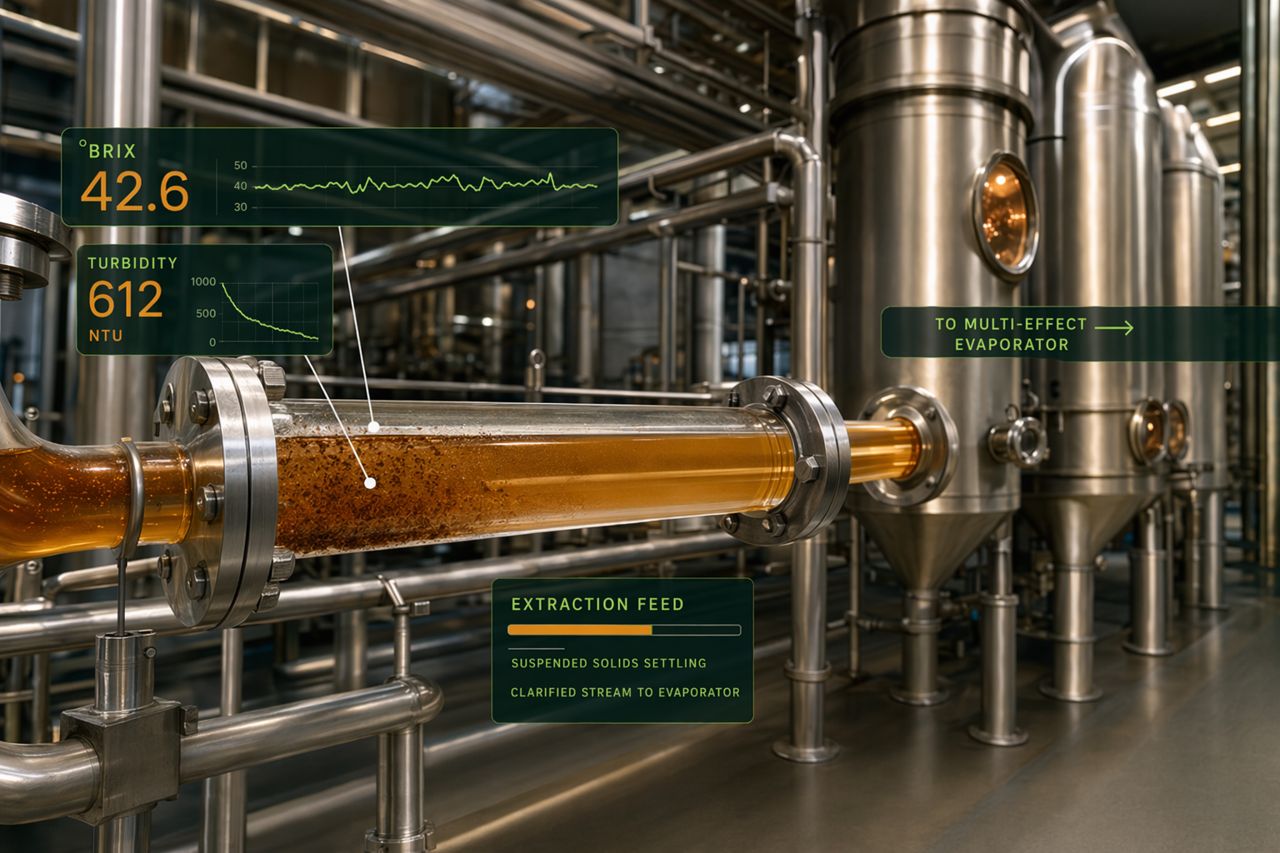
- Feed °Brix into the evaporator
- Concentrate °Brix leaving each effect or stage
- Turbidity before and after clarification
- Viscosity trend during concentration
- Heat-transfer decline over production time
- Cleaning frequency and caustic demand
- Color shift through concentration
- Flavor impact from extended thermal exposure
If these signals drift together, the issue may be more than evaporator tuning. It may indicate that extract composition is changing upstream.
Fouling reduction is a yield and uptime issue
Fouling is not just a cleaning problem. It reduces heat-transfer efficiency, increases energy use, shortens production runs, and can force operators to lower throughput to maintain target concentration.
For instant tea processors, fouling risk often rises when extracts contain a combination of suspended fines, polymeric plant material, and thermally sensitive tea solids. Enzyme selection can support better downstream behavior by helping release target soluble components while reducing the burden of colloidal material that complicates concentration.
Practical outcomes may include:
- Longer evaporator run time between cleanings
- More stable concentration at target °Brix
- Reduced pressure to over-process extract thermally
- Smoother feed behavior into the spray dryer
- Better separation performance before concentration
Spray drying needs a stable feed, not just a strong dryer
A spray dryer can only do so much with inconsistent feed. Variability in solids, viscosity, insoluble load, and surface-active compounds affects atomization, chamber behavior, cyclone recovery, and final powder quality.
Feed consistency affects powder quality
Common powder issues linked to upstream feed variation include:
- Poor cold-water solubility
- Sediment formation after reconstitution
- Color inconsistency
- Sticky chamber deposits
- Lower powder recovery
- Variable bulk density
- Agglomeration inconsistency
- Caking during storage
When enzymatic extraction improves liquor uniformity, the dryer receives a more predictable feed. That supports more repeatable atomization, moisture removal, and powder recovery.
Protecting cold-water solubility
Cold-water solubility is a commercial requirement for many instant tea formats. It is also sensitive to extract preparation.
Solubility can be affected by:
- Residual insoluble particles
- Heat-induced complex formation
- Excessive viscosity before drying
- Incomplete clarification
- Unstable solids concentration
- Overexposure during evaporation
Enzymeready application work focuses on extract behavior across the full process. We look at how enzymatic treatment influences separation, concentration, and reconstitution—not only extraction yield. A small improvement in upstream clarification can have a large effect on the final cup if it reduces sediment and improves rapid dispersion.
Building a repeatable extraction-to-drying window
A reliable instant tea line depends on more than a single extraction trial. The process needs a controlled window that operators can repeat under production conditions.
Define the window around plant realities
Useful process boundaries include:
- Tea grade and seasonal variation
- Extraction temperature and residence time
- Solids target before clarification
- Enzyme addition point and contact profile
- Separation method and turbidity target
- Evaporator feed specification
- Concentrate solids target
- Spray dryer feed temperature and viscosity range
- Powder solubility and sediment specification
The best enzyme program is practical on the plant floor. It should fit the equipment, cleaning regime, batch or continuous extraction format, and quality targets already used by the production team.
Where enzyme selection matters
Different tea raw materials respond differently. Black tea, green tea, oolong, tea dust, fannings, and extract blends can carry different levels of cell wall material, soluble solids, fines, and polyphenol behavior.
For evaporation and drying consistency, enzyme selection should consider:
- Yield recovery without excessive insoluble carryover
- Clarification compatibility
- Viscosity control before concentration
- Protection of color and flavor profile
- Reduced fouling tendency
- Final powder solubility
- Fit with existing residence time and temperature conditions
This is why Enzymeready does not treat enzyme supply as a catalog decision. We help processors connect the enzyme program to the actual extraction and drying constraints in the plant.
Practical plant checks before changing conditions
Before changing evaporation temperature, dryer inlet settings, or atomization conditions, review the extract entering those steps.
Ask these questions:
- Is turbidity stable before evaporation?
- Does evaporator feed °Brix vary by batch or shift?
- Is viscosity rising faster than expected during concentration?
- Are cleaning intervals shortening after certain tea lots?
- Does powder solubility decline when concentration is pushed higher?
- Are dryer deposits linked to specific extraction runs?
- Is sediment in the final drink coming from extract fines or drying damage?
These questions help separate equipment limitations from extract variability.
Enzymeready support for instant tea processors
Enzymeready works with instant tea extraction plants that need practical enzyme programs for yield recovery, clarity, evaporator performance, and spray drying consistency.
We can support discussions around:
- Enzyme selection for tea extraction processing
- Plant-fit dosing strategy without disrupting current workflow
- Clarification and turbidity improvement goals
- Evaporation feed stability
- Fouling reduction targets
- Cold-water solubility and sediment control
- Scale-up from trial batches to production windows
Request a quote
If your plant is working to improve extract consistency before evaporation and spray drying, Enzymeready can help define an enzyme approach matched to your tea type, equipment, and production targets.
Request a quote through the on-site form and share your tea material, extraction format, current bottleneck, and target powder specification.